Have you ever noticed that, on packages from the EU, there is much more information shown than on Ukrainian ones? For example, ― the amount of fiber, salt, trans-fats and so on. Besides this, in the EU, there are labeling marks that show right away ― the product is healthy or not.
Such labeling systems aim to inform customers quickly about the level of product safety. In the European Union, the struggle against obesity and food-related diseases has been conducted for some time now: public health organizations raise food awareness in society by organizing information campaigns, and they are also fighting with product corporations, which have to display all the information related to the product nutritional value and dangers, if there are any, on the package.
The most common labeling systems
Nutri-score ― is a system that is made of 5 letters: A, B, C, D and E, ― where A means a product that has the highest nutritional value, and E indicates the lowest. The algorithm of Nutri-score compares harmful and healthy food components: adds scores for fiber, proteins, fruits, vegetables and nuts; the scores are removed if a product contains too many calories, salt, saturated fats and sugar.

The system was designed in France and selected by the French government as the most effective as compared to other systems. Also, Nutri-score is recommended in Belgium, Spain, Germany and Denmark. But this is only a recommendation ― producers are not forced to label with Nutri-score.
Yuka ― is a French startup that developed a mobile application for calculating the nutritional value of products. You just scan a barcode and the information appears on the screen. The algorithm is similar to Nutri-score and is based, primarily, on the balance of healthy and harmful components.
Siga ― is a system very different from Nutri-score and Yuka as it defines the nutritional value based not on the components, but on the level of their processing: the more a product is processed, the less value it has; for example, an apple is healthier than juice or jam. Siga can be compared with a system designed in Brazil ― Nova. Nova also classifies products using the level of processing and showed very good results.
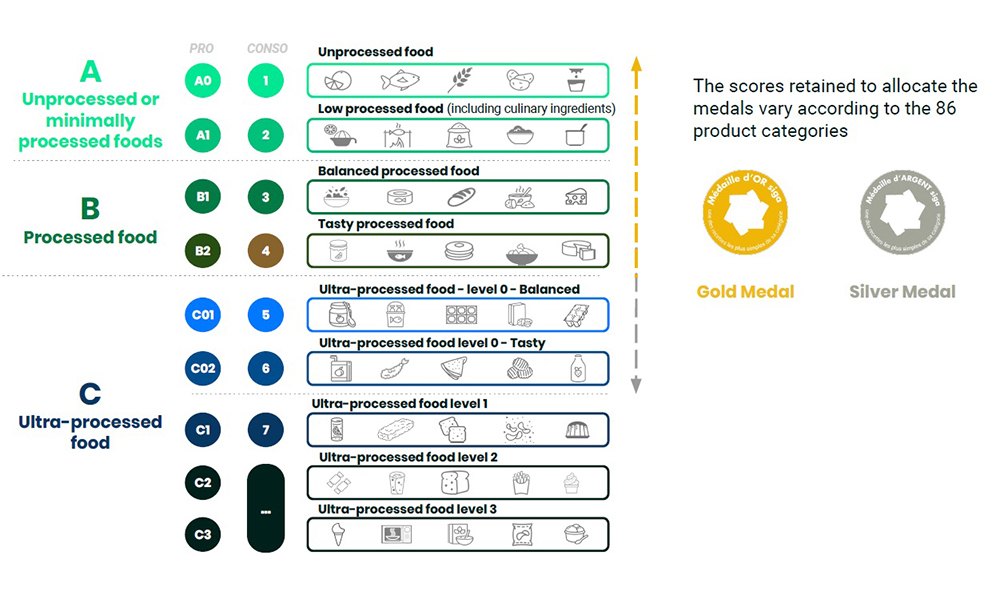
Siga labeling is used by French brand Biocoop.
Advantages and disadvantages
Though Nutri-score is an important step in fighting food-related diseases, this system has its gaps. We cannot take into account only the components of a product while calculating its value ― how much the product was processed is extremely important. There were products detected that get high results in Nutri-score system, but cannot be called healthy at all. So in this case, we not just get a labeling system that doesn’t work but also encourage customers not to limit the consumption of such a fake “healthy” product.
Another disadvantage of Nutri-score is ignoring trans-fats. Somehow only saturated fats are taken into account and this doesn’t seem right at all.
Siga is a more professional system from the view of today’s nutrition science because the level of processing is being linked to negative health effects more and more now. Also, low-processed food rarely contains high levels of sugar or salt, and regarding saturated fats (can be found in meat and milk) — they are not bad for our body at all, when consumed in moderate amounts.
How to choose healthy products if there is no labeling?
In fact, even in the EU, the number of labeled products is low. Moreover, as we’ve already discovered, existing systems are far from being perfect, so, for now, it’s better to learn the main principles of healthy eating on our own. In general, nutritionists advise buying packed products as little as possible: healthy food is not the food that can be stored in a package for months, conserved in sugar, salt and low-quality fats. Healthy food means vegetables and fruits, fish, eggs etc. When you enter a store, try to move around the perimeter ― that’s where perishable produce and refrigerators can be found. Avoid rows in the middle — they have a lot of high-processed products (except the rows with grain products).
The implementation of labeling systems is important for global changes in public health. We made tobacco companies display frightening photos of the diseases caused by smoking on the package, so why do we allow food companies to keep feeding us with diabetes, obesity, heart disease and remain silent?
Let’s hope that Ukraine will start the implementation of the labeling systems very soon, but until then ― we have to stay cautious.
Sofiia Zabiiaka, OrganicInfo